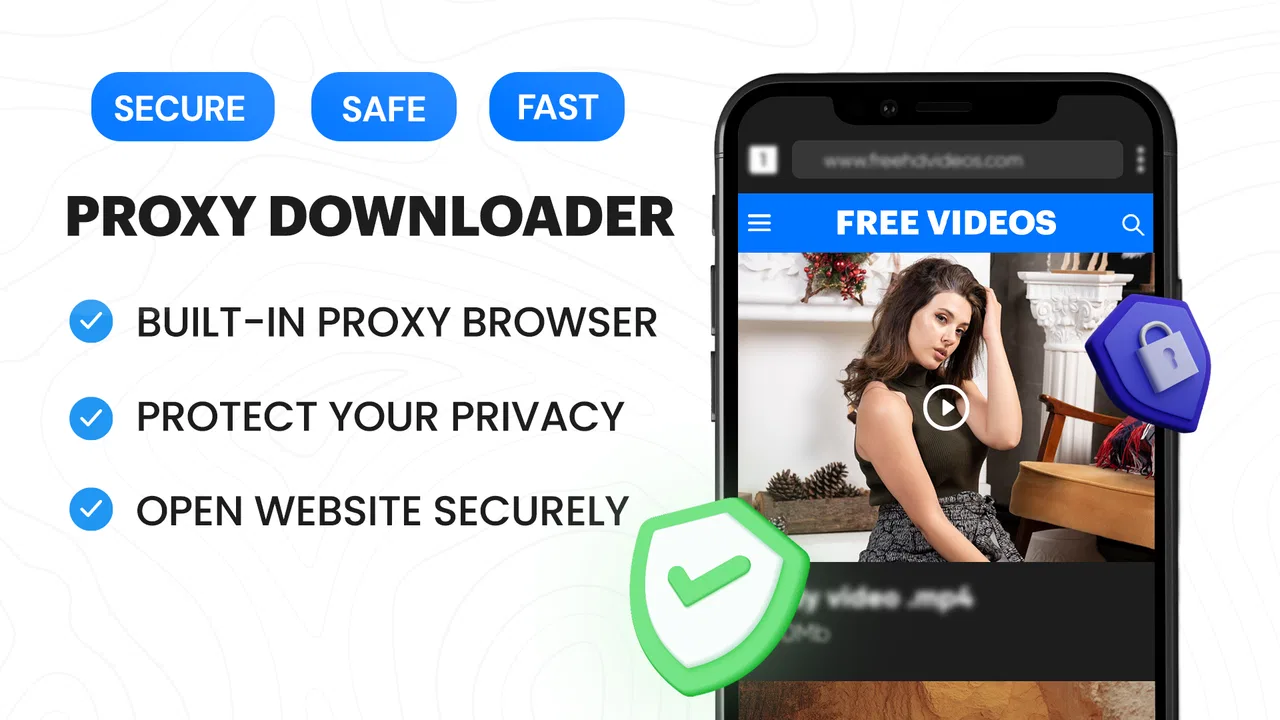
Video Downloader Proxy Browser
- 4.1
- Rating
- 10.00M
- Installs
- Free
- Price

 Analysis by App-foxy
I approached Video Downloader: Browser Home as a practical tool for one simple situation: I find a video while browsing, want to keep it available for later, and would rather handle the search, download, and playback in one place. That workflow is the app’s real appeal. It is a free Android video player and editor-category app from Video Downloader App Developer, built around a private browsing experience, video saving, and an integrated player rather than a complicated editing suite.
My first impression was that it is aimed at convenience more than creative production. You open the built-in secure browser, locate the video, and use the app as the bridge between online viewing and offline playback. That makes it interesting for people who dislike jumping between a browser, a file manager, and a separate media player. It is available to Everyone, supports Android 8.0 and newer, and the current version is 7.3, so the basic audience is broad.
From finding a video to watching it offline
When I’m deciding whether a video belongs on my phone, I find it useful to think through the whole route: finding a suitable source, saving only what I’ll actually use, and checking the result before I rely on it. That makes the convenience of a single-app workflow easier to judge against storage and compatibility trade-offs. Next, I look at what happens when that simple routine turns into heavier use.
You May Also Like

 Blood Strike: 2.5 Anniversary
Blood Strike’s Loadouts Turn Every Drop Into a Tactical Gamble
A close look at Blood Strike’s custom loadouts: how fast access to signature weapons reshapes its battle royale rhythm, rewards preparation, and narrows the gap between fights.

 Pandora - Music & Podcasts
Pandora’s Music Is Easy to Start, but Harder to Recover
Pandora’s strength is its low-effort path from a seed to a station. Its weak spot is how much confidence it asks you to place in connection, setup, and quiet recovery.

 8 Ball Pool
 Is Built on Rivalries, Rematches, and Routine
A close look at the rivalries, rematches, shared routines, and unanswered safety questions that turn a quick pool match into a persistent mobile community.

 Samsung Music
’s Quiet Strength Is Playing What You Already Own
Its reach comes less from spectacle than from dependable access to a personal library. That simplicity is both the app’s strongest retention engine and its ceiling.

 AccuWeather: Weather Radar
AccuWeather Review: A Quick, Clear Forecast for Everyday Decisions
For everyday plans, the best forecast is the one you can understand quickly. AccuWeather makes rain timing, radar, and local conditions easy to act on, with a few trade-offs.

 Hill Climb Racing
Why Hill Climb Racing Still Turns Crashes Into One More Run
A tiny car, a bumpy hill and one more upgrade: Hill Climb Racing keeps resurfacing because its simple chaos makes every near-miss feel personal.
More From Our News Desk



The starting condition: a browser-first approach
The most useful way to think about this app is not as a general-purpose downloader that magically handles every video source. It is a browser-based workflow. I start inside the app instead of copying a link from another browser, search for or open the page containing the video, and then decide whether the content is suitable for saving. Keeping that first step inside the same application removes one small but surprisingly annoying handoff.
This is especially handy when I am browsing on a phone and come across a clip I want to revisit during a commute, in a place with unreliable reception, or simply at a later time. The built-in browser gives the process a single starting point, while the integrated player means the saved file does not need to be opened immediately in another app.
The word “private” in the app’s positioning also affects how I approach it. I would use it for ordinary browsing and personal media organization, but I would still avoid treating any browser as a substitute for careful online habits. A secure browsing label can be reassuring, yet it does not remove the need to check what I am opening or saving. I also make sure I have permission to download material, since convenience does not change the rights attached to a video.
Step one: locate the source inside the app
The first practical advantage is that I do not need to leave the downloader to begin. I can use its browser to move from a page to a video, which is more direct than finding a clip in one application, copying its address, switching to a downloader, and then pasting it. On a small screen, those extra transitions are where mistakes happen: the wrong link gets copied, the page reloads, or the browser loses the place I was viewing.
That said, the browser is also the point where compatibility matters most. Online video pages are not all built alike. A straightforward page with a recognizable playable video is a better candidate for this workflow than a service that relies heavily on accounts, protected playback, changing layouts, or content that is deliberately restricted from downloading. I would not install this expecting it to bypass those limits.
A useful habit is to wait until the video is visibly ready before trying to save it. Starting too early can leave me working with the page rather than the actual media. If the app presents more than one possible video item, I would check the context and choose carefully instead of tapping the first option automatically. That small pause helps avoid saving a short preview, an advertisement, or an unrelated clip from the same page.
Step two: choose the download deliberately
Once the video is recognized, the download stage is where I would slow down and consider the outcome I want. If I only need to watch something once, streaming may be simpler. Saving makes more sense for repeated viewing, travel, study material that I am authorized to keep, or a personal collection of clips that I want available without returning to the original page.
The app’s free entry point makes it easy to test this workflow without committing money first. There are in-app purchases ranging from $1.99 to $15.99 per item, so I would check the purchase screen carefully before confirming anything. I would also avoid assuming that an optional purchase automatically solves a source-compatibility problem. A paid option may improve convenience, but it should not be treated as a guarantee that every website or video format will work.
For storage, my advice is to think beyond the download button. Video files can consume space quickly, especially when I save several clips without reviewing them. I would keep a simple routine: download only what I expect to use, watch or review it soon, and remove files that no longer serve a purpose. This matters more on a phone with limited free space than the initial download itself.
Step three: let the built-in player complete the handoff
The built-in video player is the part that makes the app feel like a complete loop rather than a single-purpose downloader. After saving a file, I can move directly into playback instead of searching through a separate gallery or media application. For a quick check, that is efficient: I can confirm that the right clip was saved and decide whether it is worth keeping.
This handoff is also useful when I am sorting several downloads. I can play a file immediately, identify a duplicate or an unwanted result, and clean up while the context is still fresh. That is a better workflow than allowing a pile of anonymous files to accumulate until I no longer remember why I saved them.
I would still compare the integrated player with the dedicated media player already on my phone. A specialist player may offer broader format support, more playback controls, casting options, subtitle handling, or a more mature library view. The built-in player wins on speed and continuity, not necessarily on depth. If my priority is advanced playback management, I would use this app to obtain authorized files and another player for the viewing stage.
The result: a compact offline routine
When everything lines up, the result is pleasantly simple: I browse, save, and watch without leaving the same application. That is the strongest reason to choose it over a conventional browser combined with a separate downloader. The fewer handoffs make the process easier to remember, particularly for someone who is not comfortable managing copied links, download folders, and multiple media apps.
A realistic example would be preparing for a long trip. Before leaving, I could open the browser, find a few videos I am allowed to save, download only the ones I genuinely plan to watch, and play each one once to confirm the result. Later, I would open the player rather than depend on a mobile connection. The useful outcome is not just having files on the phone; it is knowing that the files are identifiable and playable before I need them.
Another good use is temporary reference material. If I am learning from a permitted instructional video, saving it can make repeated review less dependent on network quality. I would keep the collection small and organized around a clear purpose, because the app is most comfortable as a focused browser-to-player tool rather than a full digital library manager.
Where the flow breaks
The first weak point is source support. A built-in browser can simplify navigation, but it cannot make every website compatible with downloading. Pages that hide the media behind protected playback, accounts, unusual embedded players, or frequently changing interfaces may interrupt the process. In those cases, the app may be less useful than the original service’s own offline feature, when one is available.
The second weak point is the difference between “video downloader” and “video editor.” The app belongs to the Video Players & Editors category, but the practical experience I would expect from its description centers on browsing, downloading, and playback. Someone looking for trimming, transitions, captions, filters, timeline editing, or export controls should choose a dedicated editor instead. The category label should not lead them to expect a complete editing workstation.
There is also a privacy trade-off in using an all-in-one browser. The convenience of keeping browsing and downloads together is valuable, but it means I would pay attention to the app’s behavior and avoid entering sensitive information casually. For ordinary media discovery, that may be acceptable. For banking, work accounts, or confidential browsing, I would use the browser I already trust and keep this app focused on its intended media workflow.
Storage management can become another source of friction. The app makes saving easy, which is helpful until easy saving turns into clutter. I would treat each download as a decision rather than a bookmark: ask whether I need offline access, whether I have permission, and whether I can remove it after viewing. That approach prevents the downloader from becoming an unstructured archive.
How it compares with the usual alternatives
Compared with a standard mobile browser, this app is more convenient when the goal is to move from a video page to local playback. The browser alone is better for broad web tasks and may already connect smoothly with the services I use, but it does not offer the same focused download-to-player path.
Compared with a website-based downloader, the app feels more consistent for repeated use because I do not have to visit a different service every time. A web tool may be quicker for a one-off task, but it can introduce extra redirects, confusing buttons, or an interface that changes from one visit to the next. I would favor this app when I regularly perform the same authorized workflow on my phone.
Compared with a streaming service’s official offline mode, the official option is usually the safer choice when it is available and fits my needs. It keeps content within the service’s own system and may handle access rules more clearly. This app is more appealing for compatible sources and personal files that I want to manage through a browser and player in one place.
Compared with a dedicated media player, the advantage here is not advanced playback. It is the route from discovery to viewing. If I already have videos stored locally and only want the best playback controls, I would look elsewhere. If I repeatedly find videos online and want a single app to handle the next step, this one has a clearer reason to exist.
Who will get the most from it
I think the app suits Android users who value a short, self-contained workflow. It is particularly practical for people who often save personal or permitted online videos, want a built-in browser, and prefer checking downloads immediately in an integrated player. The broad age rating and free availability also make it easy to try without turning the decision into a major purchase.
It is less suitable for someone who expects universal website compatibility, sophisticated editing, cloud synchronization, or a feature-rich media library. I would also skip it if my main need is simply watching content from a service that already provides a polished official offline mode. In that situation, adding another downloader may create more steps rather than fewer.
The app’s reach suggests that this focused approach resonates with a large Android audience: it has passed ten million installs and holds a 4.3 average from around twenty-four thousand ratings. I read that as evidence of broad usefulness, not proof that every source will work perfectly. The smaller review count shown alongside those ratings also reminds me to judge the app by my own workflow rather than by popularity alone.
Practical expectations before installing
Because it is free, I would install it first for a small, low-risk test: open a familiar page, try one video that I am permitted to save, play the result, and then inspect whether the process feels clear. This tells me more than assuming the app will handle every site I visit. I would not begin by attempting a large batch of downloads or relying on it for an important trip before checking the exact sources I need.
I would also confirm that my phone runs Android 8.0 or newer and remember that optional purchases may appear in the experience. The developer is listed as Video Downloader App Developer, and the current release is 7.3. Those details make the app easy to identify when comparing versions, but the more important test is still practical: can it recognize my intended videos, save them cleanly, and play them afterward?
My final view is that Video Downloader: Browser Home is strongest when I treat it as a streamlined bridge between browsing and offline playback. It reduces the usual copying, switching, and file-hunting, and the integrated player gives the workflow a satisfying finish. Its limits are equally important: protected or unusual sources may stop the process, the player is not necessarily a replacement for a specialist one, and the app should not be confused with a full video editor.
I would recommend it to a friend who wants a straightforward Android tool for authorized downloads and quick playback, especially if that friend is tired of juggling several apps. I would suggest testing the exact websites they care about before relying on it heavily. For the right starting condition, the path from input to outcome is refreshingly direct; when compatibility or advanced media features matter more than convenience, a browser’s official offline tools or a dedicated player will be the better choice.
FAQs for Video Downloader Proxy Browser
01What platforms is Video Downloader: Browser Home available on?
Video Downloader: Browser Home is available on both Android and iOS platforms. Users can download it through the Google Play Store or the Apple App Store, ensuring compatibility with a wide range of smartphones and tablets. Make sure your device meets the minimum system requirements for optimal performance.
02Is Video Downloader: Browser Home free to use?
Yes, Video Downloader: Browser Home offers a free version with basic features. However, there may be in-app purchases or a premium version available that unlocks additional features, such as ad-free browsing, faster downloads, or support for more file formats. Check the app store listing for detailed pricing information.
03Can I download videos from any website using Video Downloader: Browser Home?
Video Downloader: Browser Home supports downloading from a variety of popular video-sharing websites. However, it may not work with all websites due to restrictions or copyright protection. Always ensure you have the right to download content and comply with the terms and conditions of the hosting site.
04How user-friendly is the interface of Video Downloader: Browser Home?
Video Downloader: Browser Home features a straightforward and intuitive interface, designed to make downloading videos easy even for beginners. The integrated browser allows you to navigate directly to your desired content, and the download button is prominently displayed for quick access. Users report a smooth, hassle-free experience.
05What formats and resolutions does Video Downloader: Browser Home support?
The app supports multiple video formats such as MP4, AVI, and MOV, among others. It also allows downloading in various resolutions, from standard definition to high definition, depending on the source video's availability. This flexibility ensures you can download videos that meet your storage and quality preferences.
Pros
- Easy-to-use interface simplifies downloading.
- Supports multiple file formats for versatility.
- Built-in browser enhances user convenience.
- Fast download speeds save users time.
- Allows background downloads for multitasking.
Cons
- Ads can be intrusive during usage.
- Limited features in the free version.
- Requires permissions that may concern privacy.
- Not all websites are supported for downloads.
- Occasional crashes reported by some users.

Video Downloader Proxy Browser
Gallery